Common Succulent Mistakes That Slowly Kill Your Plant
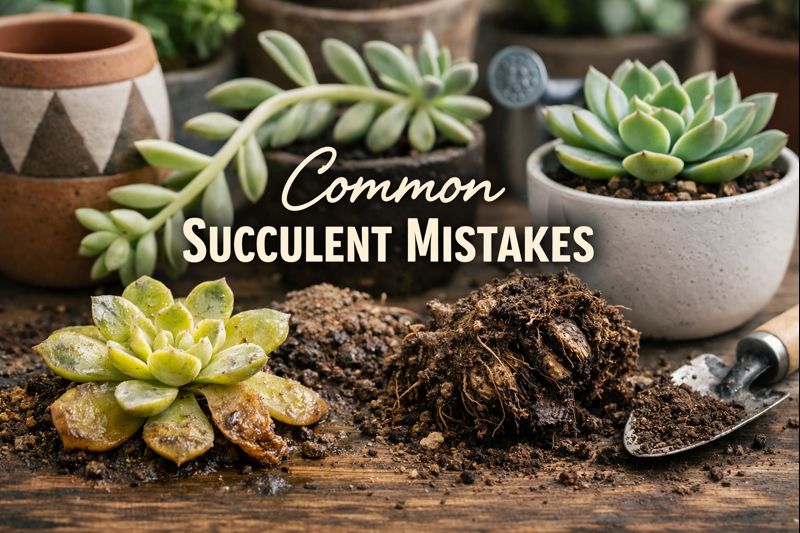
Succulent Plant Mistakes That Slowly Kill Your Plant
Succulents have a reputation that feels almost unfair.
They are marketed as tough, forgiving, and perfect for people who forget to water.
So when one starts looking sad on your windowsill, it can feel confusing and personal.
I have met many first time succulent parents who swear they did everything right.
Bright pot, good intentions, a little water here and there.
And yet the plant still declined quietly, without drama or warning.
The truth is this.
Most succulents do not die suddenly.
They fade slowly because of small habits that feel harmless at the time.
This article is not about blame.
It is about understanding what succulents are quietly asking for, especially indoors, especially in small spaces, especially when life is busy.
The idea that succulents are easy can be misleading
Succulents survive harsh environments in the wild.
But surviving and thriving are two very different experiences.
Indoors, they rely entirely on us to interpret their needs.
Many beginners treat succulents like decorative objects.
Something you place, admire, and occasionally tend to.
Plants do not work that way, even the tough ones.
When expectations are wrong, care becomes accidental instead of intentional.
That is often where the slow damage begins.
Watering on a schedule instead of watching the plant
This is the most common mistake I see.
Watering every week because a calendar reminder says so.
Or watering every Sunday because that feels responsible.
Succulents do not care about your schedule.
They care about how dry their soil actually is.
And indoors, soil dries much slower than people expect.
When roots sit in moisture too long, they suffocate.
The leaves may still look firm for weeks.
By the time softness appears, the damage is already deep.
Why dry soil means really dry soil
Many people stop watering when the top of the soil feels dry.
That is not enough for succulents.
The moisture below the surface matters far more.
Succulent roots need air as much as they need water.
If the lower soil stays damp, roots slowly rot.
This process is quiet and easy to miss.
Waiting longer feels uncomfortable at first.
But learning to trust dryness is one of the most important succulent skills you can build.
Using regular potting soil because soil is soil
Regular potting soil is designed to hold moisture.
That is wonderful for leafy houseplants.
It is disastrous for succulents.
Succulent roots are not built for soggy environments.
They expect quick drainage and lots of air pockets.
Dense soil removes both.
If your plant looks fine above the surface but keeps declining, check the soil.
Often the problem is hidden where you cannot see it.
Loving your succulent a little too much
This one surprises people.
Touching the leaves often.
Moving the pot around every few days.
Succulents prefer stability.
They do not enjoy frequent changes or constant handling.
Stress builds quietly when conditions keep shifting.
Sometimes the best care is restraint.
Observation instead of intervention.
Letting the plant settle and adjust.
Low light corners and slow stretching
Succulents need more light than most indoor plants.
Not harsh sunlight necessarily, but consistent brightness.
Low light does not kill them quickly.
Instead, they stretch.
Leaves space out.
Colors fade.
This stretching is a survival response.
The plant is searching for light without the energy to grow strong tissue.
Once stretched, that shape does not reverse.
Decorative pots without drainage holes
This mistake is incredibly common among decor focused plant lovers.
Beautiful pots sell a dream.
But many of them trap water at the bottom.
Without drainage, excess water has nowhere to go.
Roots sit in moisture even when you water carefully.
Rot begins out of sight.
There are ways to balance beauty and function.
Inner nursery pots.
Hidden drainage trays.
Style does not need to cost your plant its life.
Treating all succulents the same
Succulent is a broad category.
Some store water aggressively.
Others are more flexible.
Thick leaved varieties tolerate drought better than thin leaved ones.
Some grow actively in warmer months.
Others slow down without warning.
When care advice feels confusing, it often is.
The label does not tell the whole story.
Your plant’s behavior tells you more.
Seasonal changes still matter indoors
Even inside apartments, seasons influence plant growth.
Light angles shift.
Temperatures fluctuate slightly.
Succulents often slow down without obvious signals.
Watering habits that worked before can suddenly become too much.
This catches many people off guard.
Reducing water during slower periods can save a plant.
Noticing these rhythms takes time.
That awareness grows with experience.
Panicking over normal leaf loss
Lower leaves drying up can be completely normal.
Succulents reabsorb nutrients from older growth.
This is part of how they survive.
The panic response is often to water more.
Or fertilize suddenly.
Both can make things worse.
Learning to distinguish aging from distress is powerful.
Not every change requires action.
Sometimes patience is the healthiest response.
Overfeeding and weakened growth
Succulents do not need much fertilizer.
In fact, too much nutrition can weaken their structure.
Fast growth leads to fragile tissue.
Many indoor growers assume feeding equals care.
But succulents evolved in lean conditions.
They are built for scarcity.
If you choose to fertilize, do it gently and sparingly.
Once or twice during active growth is often enough.
When a succulent can still be saved
Not all declining succulents are lost.
Early intervention can make a difference.
Healthy roots matter more than perfect leaves.
If rot has started, propagation may be the kindest option.
Letting go of part of the plant to save the rest.
This is not failure.
Plants teach us flexibility.
They remind us that adaptation is part of growth.
Building better habits without rigid rules
Succulent care does not need strict formulas.
It needs observation.
It needs curiosity.
Watch how your plant responds.
Adjust slowly.
Trust what you see over what you were told.
Confidence comes from experience, not perfection.
Every mistake sharpens your understanding.
Even the losses teach something valuable.
A gentle ending for plant parents who doubt themselves
If you have lost a succulent before, you are not alone.
It does not mean you are careless or incapable.
It means you are learning.
Succulents reward patience and attention, not control.
They ask us to slow down and notice subtle shifts.
That skill carries far beyond plant care.
So take a breath.
Give your next plant space to be itself.
And allow yourself to grow alongside it, one quiet lesson at a time, shall you?