From Roots to Leaves: Plant Anatomy Explained in a Fun, Easy Way
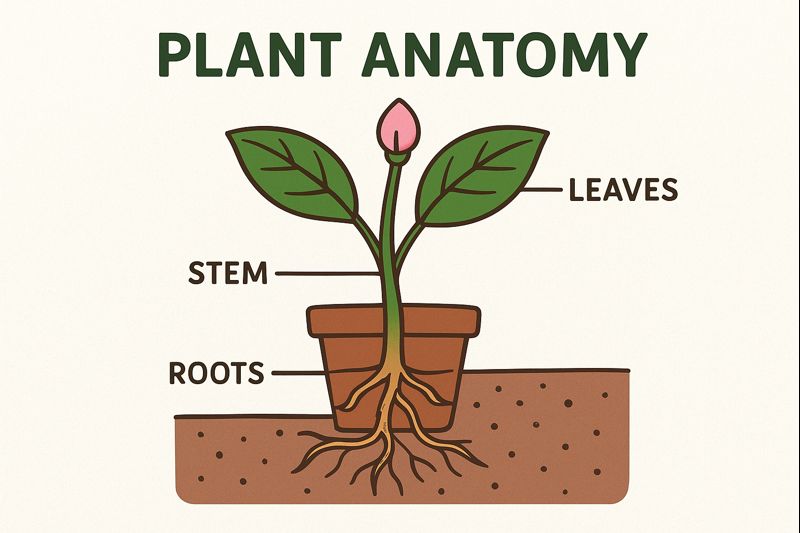
Plant Anatomy Explained in a Fun, Easy Way
Have you ever looked at your favorite plant and wondered what is really happening inside it? Many plant lovers care for their leafy companions every day yet hardly think about the inner structure that keeps everything running. There is an entire world hidden inside each plant, and once you understand it, caring for your plants becomes easier and much more rewarding. Why not peek inside the living system you water and admire every morning?
Learning plant anatomy is not about memorizing complicated scientific terms. It is simply understanding how roots, stems, and leaves work behind the scenes. When you know how each part functions, you begin to see why plants behave in certain ways. You start noticing patterns, signals, and subtle changes that tell you exactly what your plant needs. Isn’t that something every plant lover wishes they could do?
Understanding how a plant is built is a game changer for plant enthusiasts, urban gardeners, and eco-conscious indoor growers. Whether you care for succulents on a windowsill or herbs on your balcony, knowing what lies inside your plants gives you confidence and clarity. It makes plant care feel less like guesswork and more like partnership.
Why Understanding Plant Anatomy Helps You Become a Better Plant Parent
Plant anatomy answers everyday questions you might ask while caring for your plants. Why does a plant droop when thirsty? Why does it stop growing in certain pots? Why do some plants survive neglect while others collapse at the slightest stress? Most of these mysteries have simple explanations once you get familiar with how plants are built.
When you know how roots breathe, how stems transport nutrients, and how leaves create food, you begin to understand your plant almost like a friend. You notice when something feels off, and you can fix small problems before they become big ones. Doesn’t it feel good when your plant thrives because you finally understand what it was trying to tell you?
Even if you live in a tiny apartment or only own two houseplants, this knowledge makes your plant care routine feel richer and more intentional. You no longer see your plant as decoration. You see a living structure with working parts that quietly rely on you.
Roots: The Hidden Powerhouse Beneath the Soil
Roots are the foundation of plant life. They pull in water, absorb nutrients, anchor the plant, and store energy for future growth. Every time you water your plant, the first part doing the heavy lifting is the root system. It is amazing how roots can work nonstop without ever being seen. Have you ever imagined how much activity is happening under the soil while you simply watch the leaves?
Different plants have different types of roots. Taproots dive straight down, like in carrots or young trees, helping the plant reach deep water. Fibrous roots create a delicate network close to the surface that stabilizes soil and absorbs water quickly, which is why grasses bounce back so fast after stress. Then there are adventitious roots that grow from stems or leaves, allowing plants like pothos or monstera to climb and grow in unexpected ways.
Inside each root lies a clever structure. There is the epidermis, which protects the root, and the cortex, which stores nutrients and passes water inward. At the center sits the vascular system where xylem and phloem move water and minerals upward. The more you learn about roots, the more you realize how much responsibility they carry. Isn’t it wild that something so important stays completely hidden from sight?
Stems: The Support System and Nutrient Highway
Stems do far more than hold your plant upright. They transport water from the roots to the leaves and carry sugars from the leaves back to the rest of the plant. They act as storage, support, and even protection depending on the species. Every time you see new growth on a stem, it is proof that the plant’s entire inner network is working together.
Some plants have soft herbaceous stems you can bend gently between your fingers, like mint or basil. Others have woody stems that give strength and resilience to shrubs and trees. Some stems stay above ground while others hide beneath the soil, quietly storing food like ginger or potato. Isn’t it fascinating how many roles a simple stem can play?
Inside each stem are nodes and internodes. Nodes are points where leaves or branches grow, while internodes are the spaces in between. When you propagate a plant, you are using these natural structures to encourage new life. The vascular tissues inside the stem form tiny tubes that transport the plant’s lifeblood. Every time you prune or take a cutting, you are working with these hidden channels even if you do not see them.
Leaves: The Solar Panels that Keep Everything Alive
Leaves are the stars of plant anatomy because they create food through photosynthesis. They capture sunlight, pull in carbon dioxide, and release oxygen. They also regulate water through tiny pores that open and close depending on the plant’s needs. That is why a drooping leaf can be the first sign something is off. Have you ever watched a thirsty plant perk back up after watering and wondered how it happens so quickly?
Leaves come in endless shapes and textures. Broad leaves gather more sunlight, narrow leaves reduce water loss, and thick succulent leaves store moisture for dry conditions. Even the patterns on leaves tell stories about survival and adaptation. When you pay attention to leaf structure, you begin to understand where a plant naturally thrives.
Inside a leaf, the upper layers contain tightly packed cells that capture light efficiently, while the lower layers hold air spaces for gas exchange. Veins run through the leaf, transporting water and sugars to keep the plant functioning smoothly. Stomata scattered across the surface open and close like tiny mouths, balancing moisture and airflow. Isn’t it remarkable how much happens inside a single leaf you might ignore on a busy day?
Flowers, Fruits, and Seeds: The Bonus Chapter of Plant Anatomy
Not every plant in your home will bloom, but when they do, flowers reveal a whole new side of plant anatomy. They contain the reproductive structures that attract pollinators and create seeds. Petals bring color and scent, stamens produce pollen, and pistils hold the ovary where seeds eventually form. Even if you grow plants mainly for greenery, learning this part of anatomy makes propagation much more exciting.
Fruits and seeds are simply the final step in the plant’s reproductive journey. When you see a plant produce a seed, you are witnessing nature’s way of ensuring survival. Many gardeners find this part of plant anatomy incredibly rewarding because it lets them participate in the plant’s life cycle. Doesn’t it feel amazing to grow a plant from a simple seed and watch the entire structure form again?
How All Plant Parts Work Together in Perfect Harmony
A plant might look simple on the surface, but every part works together in constant communication. Roots pull in water, stems carry it upward, leaves turn it into food, and the rest of the plant uses that food for growth. If one part is stressed, the entire system feels the impact. This is why root rot affects leaves and why damaged leaves slow down growth.
When you understand how plant anatomy works as a whole, caring for your plants becomes more intuitive. You can read their signals, notice changes sooner, and respond with more confidence. Why guess what your plant wants when its own structure is already sending clear hints?
Sometimes even the behaviors that confuse you start making sense. A peace lily collapsing when dry, a pothos trailing confidently, or a succulent shriveling after too much water all come back to anatomy. Plants are constantly telling you what is happening inside them. You just need the language to understand.
Real Life Examples That Make Plant Anatomy Easier to Understand
Think about a succulent with plump leaves. Those leaves are storing water for survival, which explains why they rot quickly when watered too often. A monstera grows huge leaves because it needs to capture light in dense forests. A snake plant stands tall because its fibrous roots and strong leaves work together to store water and stay upright.
Even simple plants like pothos reveal their anatomy through behavior. Their aerial roots appear when they search for extra support or moisture. Their long stems stretch toward light because their leaves are trying to capture more energy. When you recognize these patterns, plant care feels less confusing and much more enjoyable.
Avoiding Common Plant Care Mistakes Using Simple Anatomy Knowledge
Knowing basic plant anatomy can prevent many common issues. Overwatering becomes less likely when you understand that roots need oxygen as much as they need water. Pruning becomes easier when you know new growth emerges near nodes. Light placement becomes simpler when you realize leaves act like personal solar panels.
Even if you are a beginner, this knowledge builds confidence. You stop guessing and start observing. You begin trusting your plant and your instincts. Isn’t that what every plant enthusiast hopes for?
A Closer Look Helps You Connect With Your Plants More Deeply
One of the most beautiful things about understanding plant anatomy is how it changes your relationship with your plants. You start noticing small changes in leaves, tiny roots forming on cuttings, and new stems emerging with quiet determination. Plants begin to feel like active companions rather than silent decorations.
This awareness makes your plant care routine more mindful. You water with intention, prune with understanding, and celebrate each new leaf as a tiny victory. Your home starts feeling like a living ecosystem, even if you only have a few pots on a windowsill.
Final Thoughts
There is something incredibly peaceful about discovering the hidden world inside your plants. The roots working hard underground, the stems carrying life upward, and the leaves gathering sunlight all come together in quiet harmony. When you understand this inner structure, you become a more confident and compassionate plant owner.
Plant anatomy is not complicated. It is simply the story of how your plant survives each day. And once you know that story, you never look at your plants the same way again. So the next time you see a new leaf, ask yourself this simple question: what little miracle inside the plant made that moment possible?